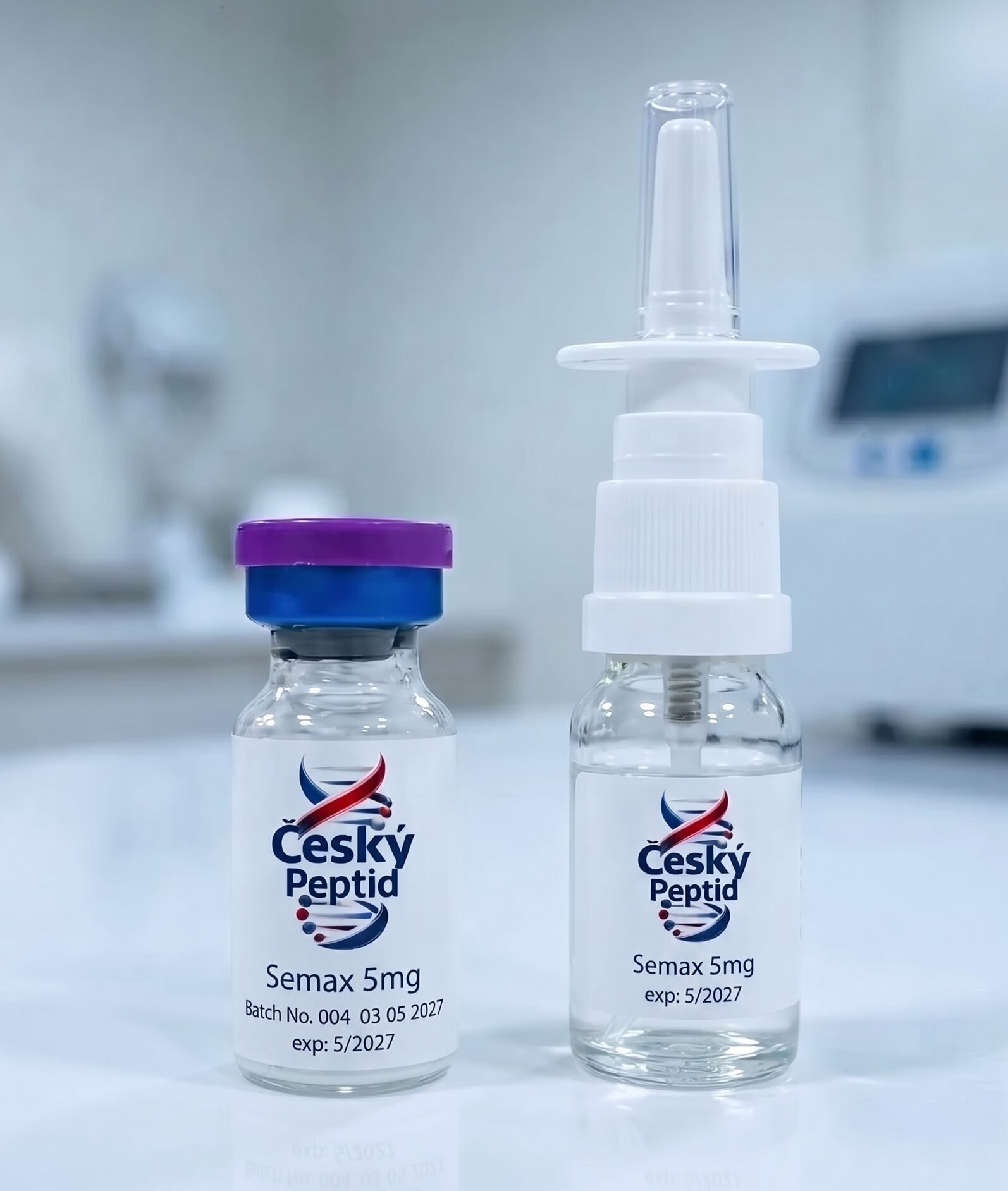
Vzhled peptidu
Lyophilized form
Ředění není součástí balení
Bakteriostatická voda
Bakteriostatická voda (3ml)
+ 99 Kč
- Cognitive Research: Evaluated in models assessing attention, memory, and task performance.
- Neuroprotection: Studied for its effects against ischemic events and environmental stress.
- BDNF Regulation: Investigated for promoting neurotrophin expression and nerve-cell survival.
- Nasal Administration: Formulated for intranasal delivery models in laboratory environments.
Dosing & Reconstitution Guide
Semax 5 mg intranasal research calculations for 5 mL final volume
Semax 5 mg Nasal Spray Calculations
Begin by reconstituting the 5 mg peptide vial with 3.0 mL of bacteriostatic water. Transfer the complete solution to the nasal spray bottle, then add additional diluent to reach the 5.0 mL measured final volume.
| Measured Final Volume | Diluent Added After Transfer | Final Concentration | Per Verified 0.10 mL Spray |
|---|---|---|---|
| 5.0 mL | About 2.0 mL | 1,000 mcg/mL | 100 mcg 50 nominal sprays |
Calculation basis: This formulation uses the full 5 mg vial and a pump verified to release 0.10 mL per complete actuation. Nominal spray counts are calculated before priming and normal residual hold-up.
- Mild redness at the injection site.
- Headache or fatigue.
- Sleep changes (temporary).
Semax 5mg
1 VIAL
Normální
2 VIALS
Sleva 10 %
3+ VIALS
Sleva 15 %
 Z-Box / Adresa
Nejnovější výsledky testů
Výsledky testů provedených nezávislými laboratořemi
Každá šarže je nezávisle testována akreditovanými analytickými laboratořemi za účelem ověření identity, sekvence a standardů čistoty (>98 %).
Safety Data Sheet (SDS)
Complete hazard analysis, physical-chemical properties, handling guidelines, and laboratory toxicological profile.
Research overview: Semax
Semax combines an ACTH(4-7)-based core with a short end sequence. This defined structure supports studies of peptide stability and nerve-cell signalling.
Studies cover brain-related markers, gene activity, ischaemia models, cognitive tasks, and stress responses. These are research settings, not a promised product result.
Gene expression and neurotrophin markers
Studies measure BDNF-related and other gene-expression changes in neural systems. These endpoints help researchers compare how study conditions affect signalling.
Other work maps brain connections and measures behaviour. Each result stays tied to the model used.
Cerebral and cognitive models
Published work also uses cerebral-ischaemia, cognitive-task, and stress models. The original study design, timing, and comparison group are needed for interpretation.
Technické údaje
Molecular profile Sequence
Met-Glu-His-Phe-Pro-Gly-Pro
Molecular mass
- 813.92 g/mol
CAS number
- 80714-61-0
Molecular formula
- C37H51N9O10S
Material record
Physical appearance
White to off-white lyophilized powder
Solubility
Soluble in bacteriostatic water and suitable aqueous laboratory solvents.
Product note: ACTH(4-10) analogue heptapeptide; supplied strictly for research use only.
Peptidy v dopravě
Peptides in lyophilized form are supplied in glass vials by standard shipping methods and do not require refrigeration. Short-term temperature fluctuations during transport will not reduce their quality and efficacy. Even at high summer temperatures, the peptides in lyophilized form are stable for several weeks.
Storage of lyophilized peptides
Lyophilized peptides should be stored in a dry place, protected from light and moisture. The following storage conditions are generally recommended:
- Room temperature (15–25 °C): Up to 3 months
- Refrigerated (2–8 °C): Up to 6 months
- Frozen (-20 °C or below): 3–5 years (recommended for long-term storage)
Allow the vial to reach room temperature after taking it out of the refrigerator or freezer.
Storage of reconstituted peptides
Once reconstituted, peptide solutions are generally less stable than their lyophilized form and should be stored under refrigerated conditions whenever possible. The following storage conditions are generally recommended:
- Room temperature (15–25 °C): Avoid prolonged storage
- Refrigerated (2–8 °C): Typically 4–8 weeks
- Frozen (-20 °C or below): Up to 3–4 months
To preserve peptide integrity, avoid repeated freeze–thaw cycles, as these may accelerate peptide degradation.
Important:
Most manufacturers recommend discarding reconstituted peptides within 4 weeks when stored at 2–8 °C. This recommendation is intentionally conservative and may not reflect the actual chemical stability of every peptide. In our own stability studies, many peptides reconstituted in bacteriostatic water showed no detectable degradation after 12 weeks of refrigerated storage. As peptide stability is highly sequence- and formulation-dependent, this result should not be extrapolated to all peptides without supporting stability data.
Scientific references and citations will be displayed here.
Každáý formulace vychází z údajů ze spolehlivých vědeckých zdrojů: