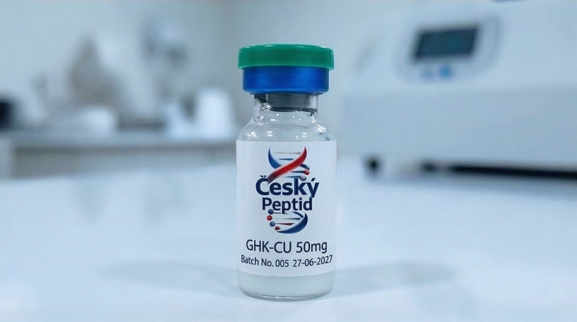
Vzhled peptidu
Lyophilized form
Ředění není součástí balení
Bakteriostatická voda
Bakteriostatická voda (3ml)
+ 99 Kč
- Tissue Repair: Widely researched for its role in extracellular matrix remodeling and wound healing.
- Anti-Aging Properties: Studied for stimulating collagen synthesis and reducing fine lines.
- Anti-Inflammatory: Evaluated for its potential to suppress pro-inflammatory cytokines.
- Hair Growth: Frequently investigated for enlarging hair follicles and promoting hair growth.
Dosing & Reconstitution Guide
Educational guide for reconstitution and common dosing patterns
Standard / Conservative Approach (3 mL = 16.67 mg/mL; 5 days/week)
| Week/Phase | Dose per Injection | Units (per injection) (mL) |
|---|---|---|
| Weeks 1-4 | 1.0 mg (1000 mcg) | 6 units (0.06 mL) |
| Weeks 5-8 | 1.5 mg (1500 mcg) | 9 units (0.09 mL) |
| Weeks 9-12+ | 2.0 mg (2000 mcg) | 12 units (0.12 mL) |
Frequency: Once daily, 5 days per week, progressing from 1.0 mg to 1.5 mg and then 2.0 mg as shown above. At 16.67 mg/mL, those doses equal 6, 9, and 12 U-100 units[18]. Use a U-100 syringe with markings that clearly display every value in the table.
- Mild flushing or warmth after administration.
- Mild redness at the injection site.
- Temporary fatigue, vivid dreams, or sleep changes.
- Slight water retention.
GHK-Cu 50mg
1 VIAL
Normální
2 VIALS
Sleva 10 %
3+ VIALS
Sleva 15 %
 Z-Box / Adresa
Nejnovější výsledky testů
Výsledky testů provedených nezávislými laboratořemi
Každá šarže je nezávisle testována akreditovanými analytickými laboratořemi za účelem ověření identity, sekvence a standardů čistoty (>98 %).
Safety Data Sheet (SDS)
Complete hazard analysis, physical-chemical properties, handling guidelines, and laboratory toxicological profile.
Research overview: GHK-CU
GHK-Cu combines a defined three-amino-acid peptide with copper. Its complex form, copper binding, and analytical identity matter when studies are compared.
Studies cover matrix-related cell work, microbial tests, nervous-system models, and gene activity. They provide research context, not a promised result for this material.
Copper binding and matrix models
Studies measure copper binding, fibroblast activity, collagen markers, and extracellular-matrix signals. These topics support controlled chemistry and cell-culture work.
Gene-expression studies must be read with their exact tissue, timepoint, and test method.
Microbial and neural research
Other studies use microbial tests and nervous-system models. These model types should be read separately instead of combined into one broad claim.
Technické údaje
Molecular profile Sequence
Gly-His-Lys
Molecular mass
- 401.91 g/mol
CAS number
- 89030-95-5
Molecular formula
- C14H22CuN6O4
Material record
Physical appearance
Blue to blue-green lyophilized powder
Salt form: 1:1 GHK–Cu(II) complex
Solubility
Soluble in bacteriostatic water and suitable aqueous laboratory solvents.
Product note: Copper-binding tripeptide complex; supplied strictly for research use only.
Peptidy v dopravě
Peptides in lyophilized form are supplied in glass vials by standard shipping methods and do not require refrigeration. Short-term temperature fluctuations during transport will not reduce their quality and efficacy. Even at high summer temperatures, the peptides in lyophilized form are stable for several weeks.
Storage of lyophilized peptides
Lyophilized peptides should be stored in a dry place, protected from light and moisture. The following storage conditions are generally recommended:
- Room temperature (15–25 °C): Up to 3 months
- Refrigerated (2–8 °C): Up to 6 months
- Frozen (-20 °C or below): 3–5 years (recommended for long-term storage)
Allow the vial to reach room temperature after taking it out of the refrigerator or freezer.
Storage of reconstituted peptides
Once reconstituted, peptide solutions are generally less stable than their lyophilized form and should be stored under refrigerated conditions whenever possible. The following storage conditions are generally recommended:
- Room temperature (15–25 °C): Avoid prolonged storage
- Refrigerated (2–8 °C): Typically 4–8 weeks
- Frozen (-20 °C or below): Up to 3–4 months
To preserve peptide integrity, avoid repeated freeze–thaw cycles, as these may accelerate peptide degradation.
Important:
Most manufacturers recommend discarding reconstituted peptides within 4 weeks when stored at 2–8 °C. This recommendation is intentionally conservative and may not reflect the actual chemical stability of every peptide. In our own stability studies, many peptides reconstituted in bacteriostatic water showed no detectable degradation after 12 weeks of refrigerated storage. As peptide stability is highly sequence- and formulation-dependent, this result should not be extrapolated to all peptides without supporting stability data.
Scientific references and citations will be displayed here.
Každáý formulace vychází z údajů ze spolehlivých vědeckých zdrojů: