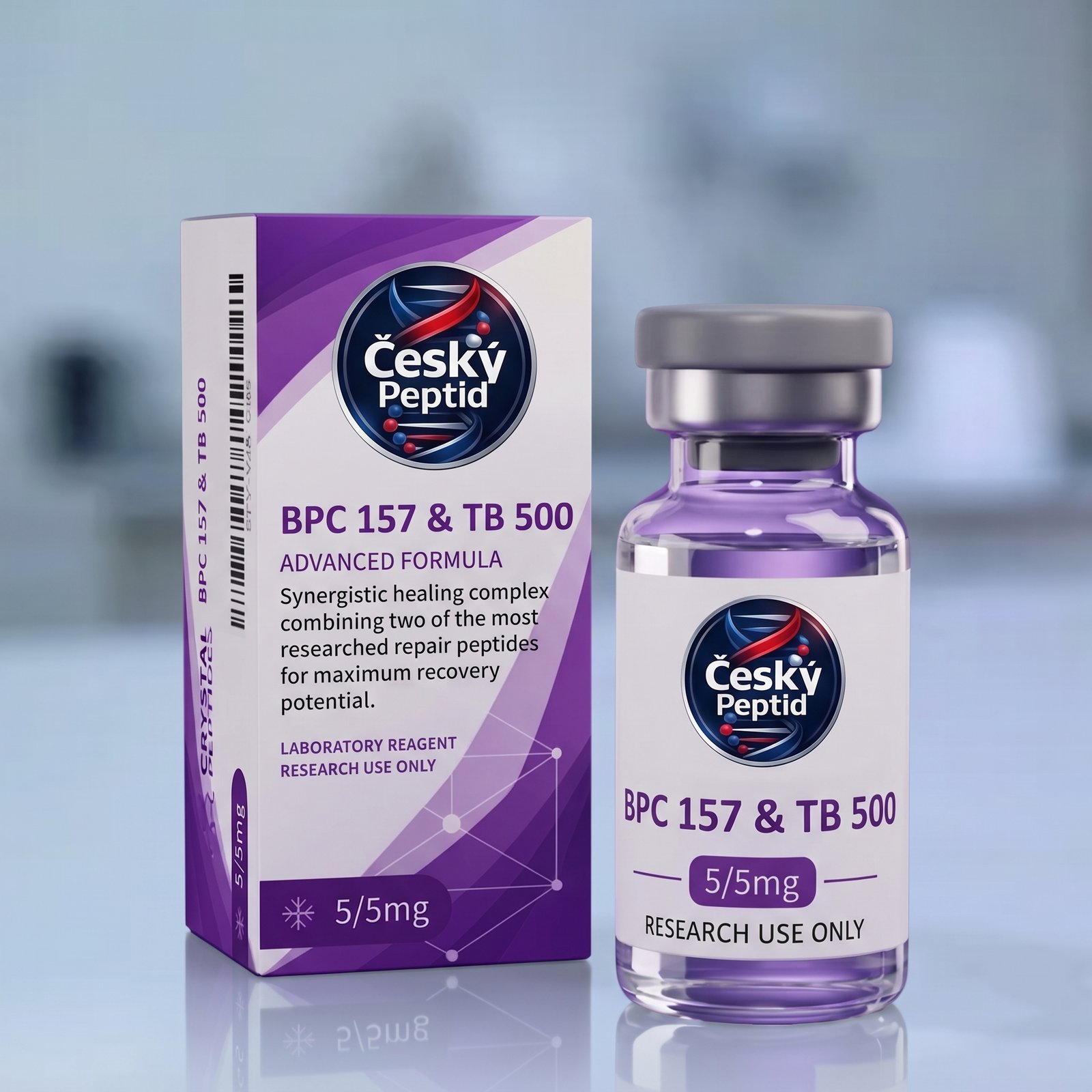
Peptide appearance
Lyophilized form
Solution not bundled
Bacteriostatic water
Bacteriostatic Water (3ml)
+ 99 Kč
- Accelerated Recovery: Dramatically speeds up cellular repair and tissue regeneration, cutting down downtime.
- Potent Anti-Inflammatory: Actively reduces systemic and localized inflammation to promote an optimal healing environment.
- Enhanced Angiogenesis: Stimulates the formation of new blood vessels, delivering vital nutrients directly to injured areas.
- Ultimate Joint & Tendon Support: Synergistically fortifies and protects connective tissues, ligaments, and joints for long-term resilience.
Educational guide for reconstitution and daily dosing
Standard / Gradual Approach (3 mL = ~3.33 mg/mL)
Route: Subcutaneous injection, once daily[5][6]. This blend contains equal amounts of BPC-157 and TB-500 (5 mg each); every dose drawn provides a 1:1 ratio of both peptides.
| Phase / Week | Daily Dose (Total) | Units (mL) |
|---|---|---|
| Weeks 1–2 (Initial) | 600 mcg | 18 units (0.18 mL) |
| Weeks 3–4 (Loading) | 800 mcg | 24 units (0.24 mL) |
| Weeks 5–8 (Maintenance) | 600 mcg | 18 units (0.18 mL) |
*Each dose provides half BPC / half TB-500
Frequency: Inject once daily subcutaneously. This schedule uses 3.0 mL dilution to keep per-injection volumes ≥18 units for accurate measurement. Rotate injection sites systematically.
- Mild redness at the injection site.
- Headache or fatigue.
- Sleep changes (temporary).
BPC-157 / TB500
1 VIAL
Normal
2 VIALS
10% off
3+ VIALS
15% off
 Z-Box / Adress
Latest test results
Third-Party Lab Results
Every batch is independently tested by accredited analytical laboratories to certify identity, sequence, and purity standards (>98%).
Safety Data Sheet (SDS)
Complete hazard analysis, physical-chemical properties, handling guidelines, and laboratory toxicological profile.
BPC-157 / TB500 combines two separately described peptide research materials in one vial. The blend should be interpreted component by component for identity, sequence, and analytical documentation rather than as a new single compound.
The listed sources are a research starting point rather than a substitute for product evidence: the supplied material’s exact form, lot, and measured characteristics must be established through its signed analytical record.
Specifications
Molecular profile Sequence
BPC-157: Gly-Glu-Pro-Pro-Pro-Gly-Lys-Pro-Ala-Asp-Asp-Ala-Gly-Leu-Val
TB-500: Ac-Ser-Asp-Lys-Pro-Asp-Met-Ala-Glu-Ile-Glu-Lys-Phe-Asp-Lys-Ser-Lys-Leu-Lys-Lys-Thr-Glu-Thr-Gln-Glu-Lys-Asn-Pro-Leu-Pro-Ser-Lys-Glu-Thr-Ile-Glu-Gln-Glu-Lys-Gln-Ala-Gly-Glu-Ser-OH
Molecular mass
- BPC-157: 1419.54 g/mol
- TB-500: 4963.49 g/mol
CAS number
- BPC-157: 137525-51-0
- TB-500: 77591-33-4
Material record
Physical appearance
White to off-white lyophilized powder
Solubility
Soluble in bacteriostatic water and aqueous solvents.
Peptides in transport
Peptides in lyophilized form are supplied in glass vials by standard shipping methods and do not require refrigeration. Short-term temperature fluctuations during transport will not reduce their quality and efficacy. Even at high summer temperatures, the peptides in lyophilized form are stable for several weeks.
Storage of lyophilized peptides
Lyophilized peptides should be stored in a dry place, protected from light and moisture. The following storage conditions are generally recommended:
- Room temperature (15–25 °C): Up to 3 months
- Refrigerated (2–8 °C): Up to 6 months
- Frozen (-20 °C or below): 3–5 years (recommended for long-term storage)
Allow the vial to reach room temperature after taking it out of the refrigerator or freezer.
Storage of reconstituted peptides
Once reconstituted, peptide solutions are generally less stable than their lyophilized form and should be stored under refrigerated conditions whenever possible. The following storage conditions are generally recommended:
- Room temperature (15–25 °C): Avoid prolonged storage
- Refrigerated (2–8 °C): Typically 4–8 weeks
- Frozen (-20 °C or below): Up to 3–4 months
To preserve peptide integrity, avoid repeated freeze–thaw cycles, as these may accelerate peptide degradation.
Important:
Most manufacturers recommend discarding reconstituted peptides within 4 weeks when stored at 2–8 °C. This recommendation is intentionally conservative and may not reflect the actual chemical stability of every peptide. In our own stability studies, many peptides reconstituted in bacteriostatic water showed no detectable degradation after 12 weeks of refrigerated storage. As peptide stability is highly sequence- and formulation-dependent, this result should not be extrapolated to all peptides without supporting stability data.
Scientific references and citations will be displayed here.
Each new formulation begins with data from reliable scientific sources: