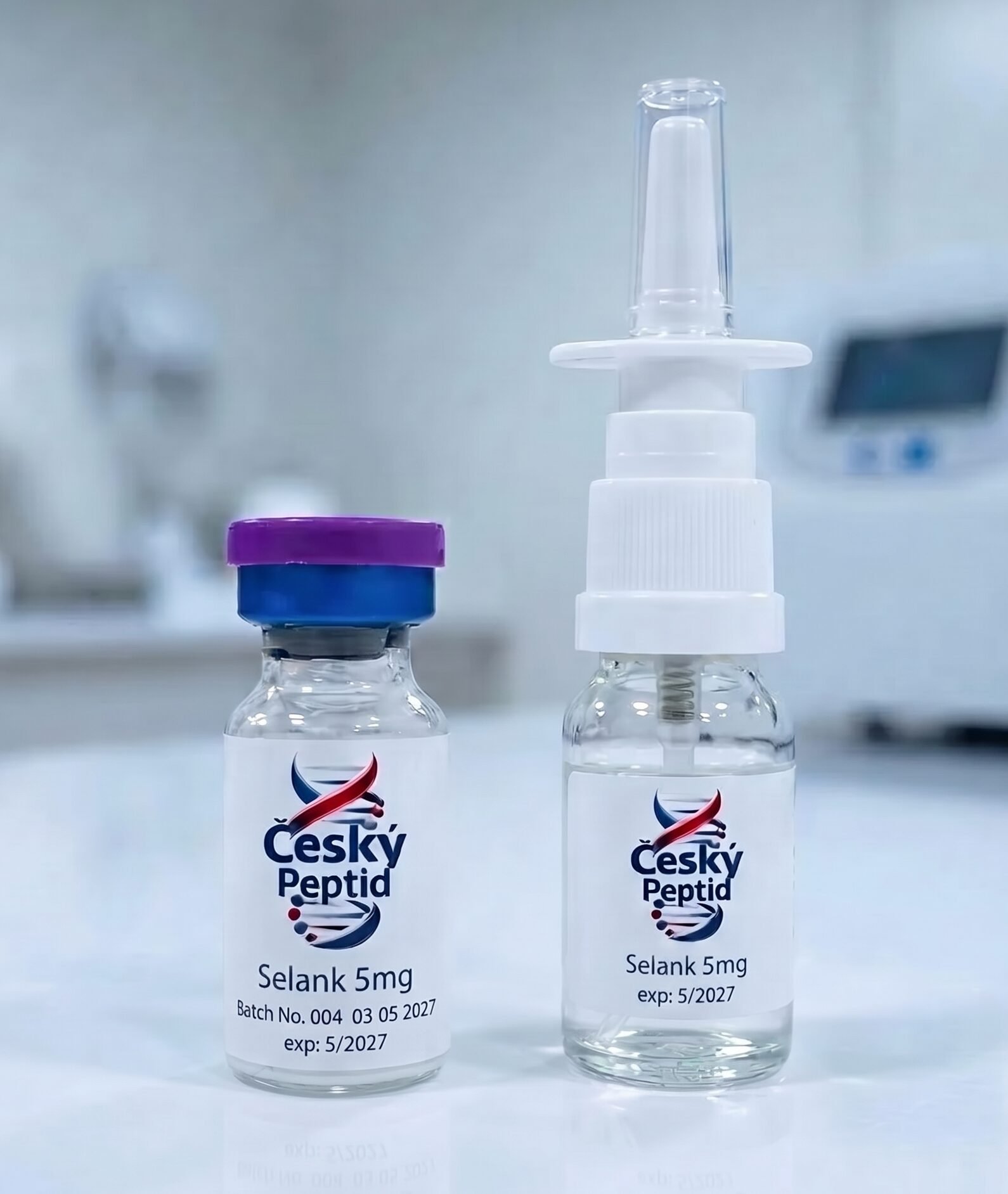
Peptide appearance
Lyophilized form
Solution not bundled
Bacteriostatic water
Bacteriostatic Water (3ml)
+ 99 Kč
- GABA-System Markers: Evaluated in models for gene activity and neurotransmitter modulation.
- Cognitive Tasks: Studied for learning and memory performance.
- Immune Signalling: Investigated for cytokine markers and nerve-immune links.
- Sensory Models: Evaluated in pain-perception and stress-response research.
| Target Dosage | Sprays Needed (0.10 mL) |
|---|---|
| 250 mcg | 1.5 sprays |
| 500 mcg | 3 sprays |
Calculation basis: 5 mg (5,000 mcg) reconstituted with exactly 3.0 mL of bacteriostatic water yields ~166.7 mcg of Selank per standard 0.10 mL spray. A 250 mcg dose requires 1.5 sprays, and a 500 mcg dose requires exactly 3 sprays (30 total sprays per vial).
- Mild redness at the injection site.
- Headache or fatigue.
- Sleep changes (temporary).
Selank 5mg
1 VIAL
Normal
2 VIALS
10% off
3+ VIALS
15% off
 Z-Box / Adress
Latest test results
Third-Party Lab Results
Every batch is independently tested by accredited analytical laboratories to certify identity, sequence, and purity standards (>98%).
Safety Data Sheet (SDS)
Complete hazard analysis, physical-chemical properties, handling guidelines, and laboratory toxicological profile.
Research overview: Selank
Selank has the sequence Thr-Lys-Pro-Arg-Pro-Gly-Pro. Its short sequence supports controlled identity, stability, and signalling studies.
Studies cover GABA-system markers, immune-cell signals, thinking tasks, and pain-response models. Each report applies only to its experimental conditions.
GABA and immune signalling
Studies measure GABA-system gene activity, cytokine markers, and links between nerve and immune signals. These are molecular and cellular research endpoints. Each paper should be read with its exact tissue, model, and timing.
Cognitive and sensory models
Other studies use learning, memory, brain-injury, and pain-perception models. These endpoints need the original protocol and comparison.
Specifications
Molecular profile Sequence
Thr-Lys-Pro-Arg-Pro-Gly-Pro
Molecular mass
- 751.9 g/mol
CAS number
- 129954-34-3
Molecular formula
- C33H57N11O9
Material record
Physical appearance
White to off-white lyophilized powder
Solubility
Soluble in bacteriostatic water and suitable aqueous laboratory solvents.
Product note: Tuftsin-derived heptapeptide analogue; supplied strictly for research use only.
Peptides in transport
Peptides in lyophilized form are supplied in glass vials by standard shipping methods and do not require refrigeration. Short-term temperature fluctuations during transport will not reduce their quality and efficacy. Even at high summer temperatures, the peptides in lyophilized form are stable for several weeks.
Storage of lyophilized peptides
Lyophilized peptides should be stored in a dry place, protected from light and moisture. The following storage conditions are generally recommended:
- Room temperature (15–25 °C): Up to 3 months
- Refrigerated (2–8 °C): Up to 6 months
- Frozen (-20 °C or below): 3–5 years (recommended for long-term storage)
Allow the vial to reach room temperature after taking it out of the refrigerator or freezer.
Storage of reconstituted peptides
Once reconstituted, peptide solutions are generally less stable than their lyophilized form and should be stored under refrigerated conditions whenever possible. The following storage conditions are generally recommended:
- Room temperature (15–25 °C): Avoid prolonged storage
- Refrigerated (2–8 °C): Typically 4–8 weeks
- Frozen (-20 °C or below): Up to 3–4 months
To preserve peptide integrity, avoid repeated freeze–thaw cycles, as these may accelerate peptide degradation.
Important:
Most manufacturers recommend discarding reconstituted peptides within 4 weeks when stored at 2–8 °C. This recommendation is intentionally conservative and may not reflect the actual chemical stability of every peptide. In our own stability studies, many peptides reconstituted in bacteriostatic water showed no detectable degradation after 12 weeks of refrigerated storage. As peptide stability is highly sequence- and formulation-dependent, this result should not be extrapolated to all peptides without supporting stability data.
Scientific references and citations will be displayed here.
Each new formulation begins with data from reliable scientific sources: